Presidential Insight
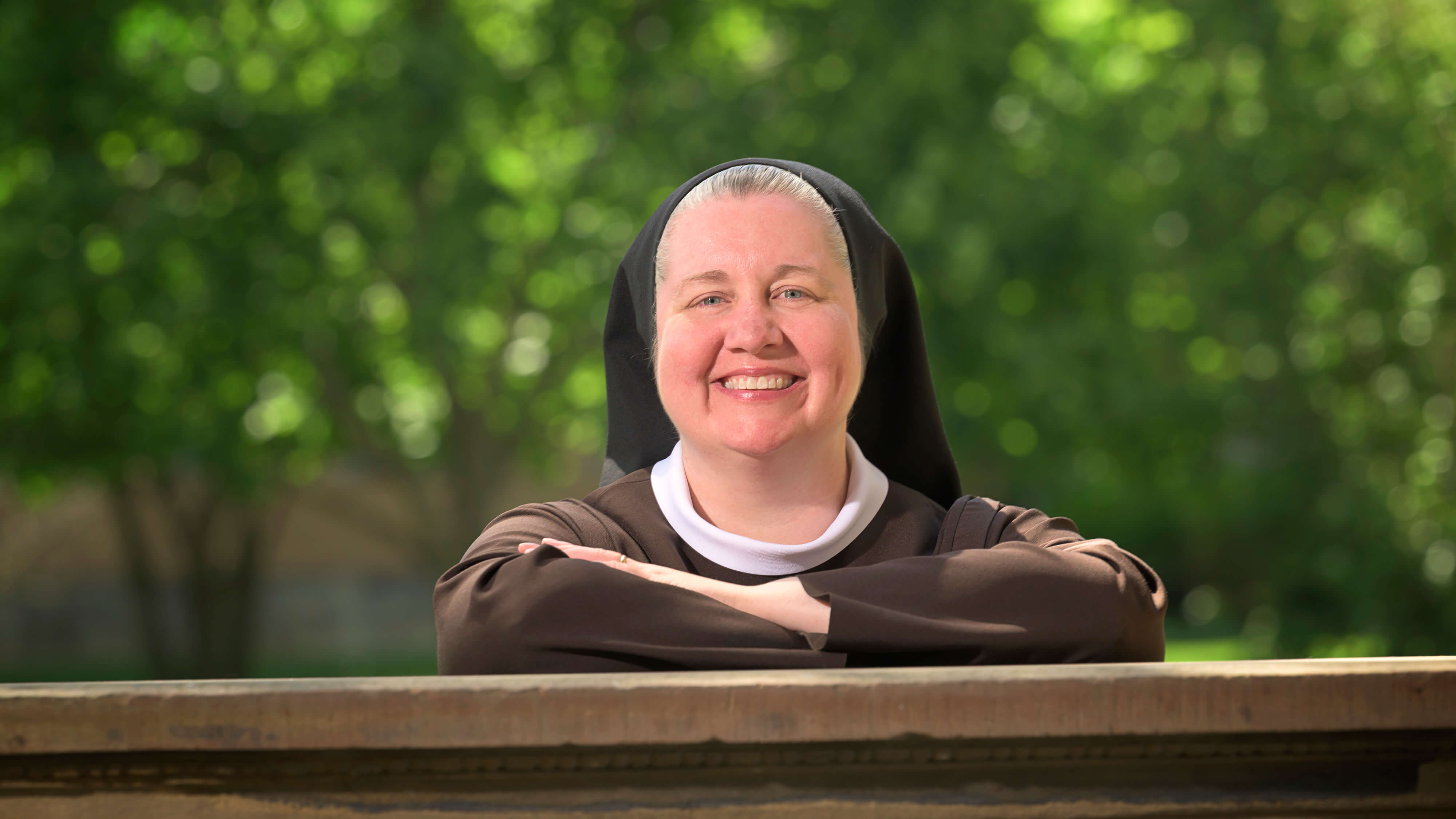
Sr. Maria Gemma Salyer, OSF, returns the university to its traditional model of a Sister as president. She exudes excitement about the journey ahead.
By Reggie Hayes
Photography by Jeffrey Crane (BA ’98)


Sr. Maria Gemma Salyer, OSF, became the 12th president of the University of Saint Francis on July 1 and was officially inaugurated on Sept. 3.
Who is Sr. Maria Gemma? What drives and motivates her? What does she envision for Saint Francis’ future? She sat down for an extended interview, touching on a variety of topics. Here is an excerpt from that conversation:
Can you describe your childhood?
I’m the oldest of three. I have a younger brother and a younger sister. My mom and dad divorced when I was in fourth grade, so we moved in with my grandparents, which was a gift in disguise because I got to grow up in my grandparents’ home. I was basically raised by my grandma, my grandpa and my mom. And my brother and sister lived with us. The gift of living with my grandparents was growing up really close to my nine first cousins. I’m the oldest. It felt like I had a really big immediate family. And I grew up going to Catholic schools.
Were you involved in athletics?
I did cheer in junior high. And in high school, I played basketball, which was kind of hilarious because I never played a day in my life. I didn’t know the rules. At our first game, I got called for double dribbling. I was so mad because I was not using both of my hands, and I could not figure out what double dribbling was. Once I learned the rules, I learned to love the game a lot more. I would say my favorite sport was softball. That was probably the sport I was the best at. I loved playing second base because there was a lot of mobility, but I played first base most often because I was tall.
You studied theology at Ohio Dominican University. How did that influence you?
The reason I’m a Sister is because of my time in college. From my freshman year theology class, I remember a professor pulling us aside after class one day, saying to me and my friends: “You are young women, you’re Catholic, you love your faith, you ought to at least think about a religious vocation. That thought blew my mind. I had never thought about becoming a Sister; I didn’t think it was a possibility for me. I had known some Sisters from my parish, but it just never struck me as a life that I would—or even could—choose. That question really stuck with me throughout college. It was something I wrestled with off and on.
Even in my sophomore and junior years, I had some time where I kind of fell away from the faith a little bit. I stopped going to Mass on Sundays and things like that. I was just wrestling with my faith. And that question would randomly pop back up. I was still in theology classes, so those questions were just really on the forefront of my mind. What is God calling you to? And thanks be to God; He never took away the gift of faith from me. I would find myself at night—sometimes in the chapel in our dorm hall—just praying, asking for His help and guidance.
When I finally decided my junior year to really start living my faith again, the first thing I did was go back to confession. You know, in the Catholic Church, we have the sacrament of confession, and that is an important sacrament for us. And right after that sacrament, I left that room, and the first thought that popped back into my mind was, “Have you ever thought about being a religious Sister?” And at that point in my journey, I just realized, you know what? I have tried to make myself happy for so long and have failed miserably. What if the God who made me and created me knows what’s going to make me happy? So, I decided to give Him a chance.
My senior year, I got involved in an outreach group on campus called St. Paul’s Outreach. And I lived in a household with six other women. We would get up and pray together. We would have meals together. And that really gave me the foundation of a faith framework that I needed to be able to step into religious life. I graduated in May and ended up entering our religious community that following September.
When was the first time you visited Saint Francis?
I came in 2006 when we had the blessing of the Pope John Paul II Center. And I remember coming for the blessing. I remember thinking, “Oh, this is wonderful.” Pope John Paul II has always been one of my favorites. He was Pope for most of my life before I entered the convent. I have just really loved his teachings on theology of the body, on consecrated life. I find him to be most inspiring. I just found it incredibly wonderful that we had a building named after Pope John Paul II.
How do you hope to engage with Saint Francis students?
I can’t wait to engage with students as president. When I was in the vice president role, I supervised student government. That was such a gift. I loved getting to know those students. They’re so talented and they have such great leadership skills. I was also over athletics and had a chance to attend the sporting events, getting to know the different athletic teams. In this role, I really have more freedom in my day in the sense that I can schedule time to go walk around to visit students.
How would you describe your leadership style?
Engaged and collaborative. I do like the framework of servant leadership. I think all leadership really is servant leadership. You ought not be leading if you’re not having a servant leadership mindset, right? Leaders are followed, but leaders also need to follow. They need to lead. They need to be decisive. They need to give clarity and set the path. And I hope to do that. But we also need to follow and be led. We need to know when to listen, when to hear, when to seek feedback, when to seek collaboration. Most of all, I need to know not to rely on myself. I’ve got a wonderful team of vice presidents. We’ve got wonderful directors across campus. It’s not a project that is just mine. It’s a project that I share, that I set direction for, but then that I share with others.
And how does being a Sister influence your leadership?
There’s a spiritual element there. And for me, leading, first of all, takes place on my knees. I have to lead by praying every morning. We get up and pray in our convent before I come to work that day. I have to do that. No one’s forcing me to do it. I have to do it to be a good leader because Jesus is the one I’m following. Jesus is the one who has the vision for this university, for everyone who works here. I need to know His heart so that I can carry out what He has planned. So as a Sister, as a spiritual leader, I also have to be cognizant that my role really is one of invitation, that I should never force anyone. I need to invite, I need to propose and I need to be a good example that others want to follow and come along with.
How encouraged are you about the future of Saint Francis?
Our university is on the verge of erupting in the best way possible. I believe there is a fire here that is just about to explode. When people who haven’t heard of it before find out about Saint Francis, they’re going to ask, where did Saint Francis come from? I truly believe the Lord has laid plans for this place.
It’s a really exciting time to lead here at the University of Saint Francis. We’re on the verge of so many things. We are finishing a strategic plan that was meant to set us up for the next plan. It was meant to accomplish those pieces, to tie those loose ends and to really launch us into a new future. And when I say a new future, we’re building on a very strong foundation, a very strong history. But as we lean into our mission, we lean into perhaps some program shifting, adding new programs, reaching students from a different market.
Where do you hope to see Saint Francis in five years?
I want to see Saint Francis as a vibrant community. When I walk across campus, I want to see students laughing with one another, talking with one another, engaging in athletic events, engaging in the classroom, excelling in the classroom. I also think we’re going to be in a place of financial stability. We have had two years of record-breaking philanthropic support. I am hopeful this momentum continues and I think we’re going to be in a healthy place to launch into the future. In five years, I hope to see Saint Francis alive. I want to see our students walking around campus, engaged, talking to one another, enjoying classes, really engaging in classes, engaging in campus activities, in athletic events. I want to see a vibrant campus community.
Who has been the biggest influence on your leadership style?
I would say Jesus is the greatest influence on my leadership. I want to be like Him when I lead. I want to see people like He sees them. And I think that’s how I will become a good leader. I also look at some of the saints in history. I look at some of the recent popes that we’ve had who have been excellent leaders. What makes them excellent is that they see the person. You can see in their eyes that they’re looking with intention. They see the dignity in the person that they approach. So those are the types of leaders I want to emulate.
What do you look forward to in your relationships with alumni?
I am really looking forward to engaging more with the alumni. We have a strong alumni base, especially in athletics. We’ve got a lot of supporters of our different athletic teams; I’ve loved getting to know them. I’m really looking forward to engaging with our alumni, especially those in the health science fields or in our other education or humanities fields, business fields, art fields. I think one of the most impactful ways alumni can be involved on campus is to come back and mentor some of our current students or provide internship opportunities to open pathways for the students that we have here.
A Five-Year Plan
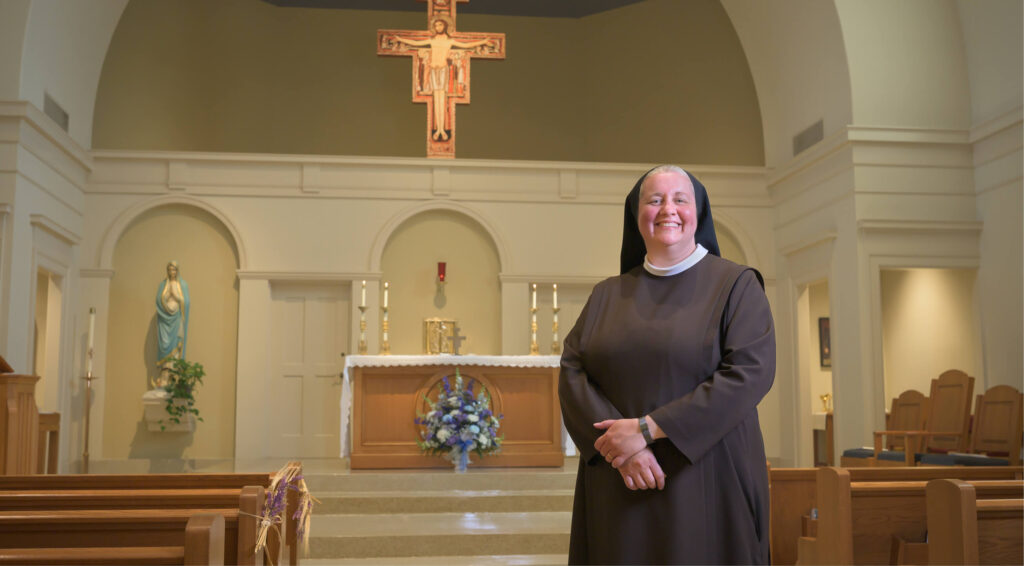
Sr. Maria Gemma sees essential elements to be tackled within the next five years to move Saint Francis forward:
• Mission Integration. “Our faculty and staff are on board with the mission. They love the mission. They’re excited to see what it means for the university. And some have legitimate questions about how to integrate the mission in their particular discipline or in their particular work. I want to be able to answer those questions for them, to give them the resources they need to be able to integrate the mission in their own way. We’re working on that with some of our mission formation and the opportunities and programs that are already underway.”
• Enhanced Student Experience. “What do students experience when they come for New Student Orientation, when they go to meet with an advisor? Is that experience similar from student to student or drastically different from one advisor to the next? We’re working on standardizing some of those experiences—not to make them impersonal, but to make sure the quality is excellent across the board.”
• Strategic Plan(s). “The current strategic plan is set to be accomplished in 2028, and we are well on our way. We need to wrap up a few pieces and then we will launch a new strategic plan.”
• Philanthropic Support. “We need to be able to grow our endowment and to grow support for the university so that we can thrive and continue to impact our students the way we do with scholarships and resources.”